Background
One early Year 1 activity asks students to share their fashion photography practice. However, some students experience heightened anxiety when viewing strong peer portfolios and can interpret critique negatively rather than as inspiration. This can also lead to a fear of presenting their work‑in‑progress in front of the cohort. These reactions indicate a need to help students reframe feedback as constructive rather than threatening. Jain (2022) argues that critical disability theory is an essential lens for developing more inclusive approaches to assessment. In response, we have discussed practical adaptations such as introducing a “buddy system” and allowing students to submit pre‑recorded video presentations. These options can help reduce anxiety, especially for students with limited English or limited confidence.
Evidence
Students face multiple hurdles in Year 1: moving to London, adjusting to unfamiliar studio environments, working with limited English, and coping with last‑minute issues such as model or stylist cancellations. Many enter the course with high expectations, so when grades do not match these expectations, disappointment can make feedback feel personal. Yet genuine learning often emerges through mistakes—a message that some students have not yet fully internalised.
“But although experience provides the vital raw material for reflection—its evidence, if you will—on its own, it does not suffice as basis for learning. It is what we do with that experience—how we convert its complex constituent elements into knowledge or understanding—that constitutes learning.”
(James and Brookfield, 2014, p. 12)
A recent microteaching activity focused on OBL reinforced these insights. During a short ten‑minute iterative design task, we were asked to improve our paper‑aeroplane designs. Some of my peers managed to improve their planes, while mine actually performed worse. However, this did not mean I learned nothing. In fact, I learned more from analysing my mistakes than from any successful attempt. James and Brookfield (2014) describe reflection as a blend of thinking, questioning and examining over time, and this exercise demonstrated that encountering a challenge or failure is central to learning. Among various reflection models, I believe that Rolfe’s “What? So what? Now what?” framework offers a simple and accessible approach for Year 1 students to begin reflective practice.
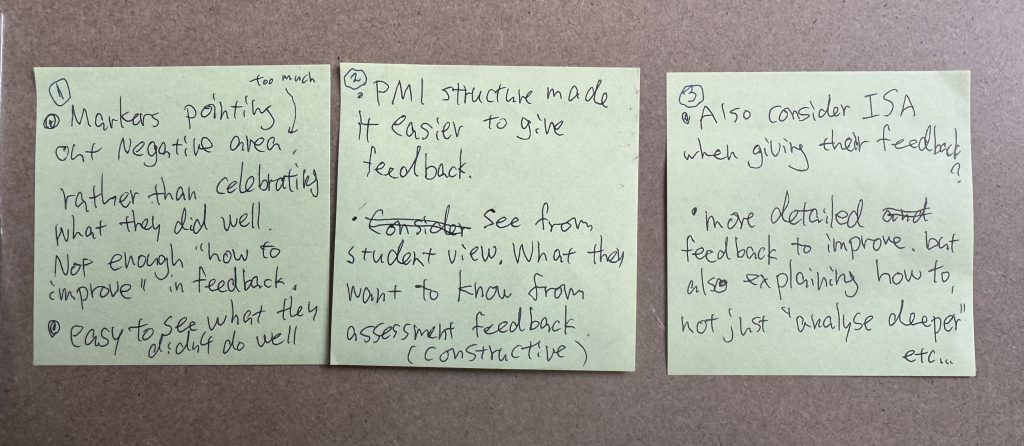
Feedback practice among markers also requires attention. Through double marking, I have observed inconsistencies in feedback language among HPL colleagues. Some comments focus on what students “did badly,” while others rely on vague directions such as “needs more critical analysis” without explaining how to do this. We are limited to 250 words of written feedback, so it is sometimes difficult to be fully descriptive. However, we must remember that our students are at the very start of their academic journey and often need clearer instruction. We must also recognise learner sensitivity and nurture a culture of caring, specific and actionable feedback—especially for students with ISA agreements. In addition, many of today’s students have been shaped by smartphones, AI, and post‑COVID study habits, all of which influence how they process information and manage pressure. This makes clear guidance and supportive structures even more essential.
Moving forward
To build confidence, the first unit should begin with short, low‑pressure pair‑feedback tasks. As students become more comfortable, we can introduce anonymous activities using tools such as Padlet or Mentimeter. These allow students to share responses without fear of judgement, helping them focus on analysing the work rather than managing stress. Giving feedback to peers is also a valuable way to develop critical thinking and communication skills. Over time, these activities support students in becoming more self‑regulated learners.
As confidence grows, WIP crits can become more meaningful and reflective. Students can be guided to offer concrete and specific comments, consider multiple perspectives from their diverse peers and tutors, and make explicit links between feedback and the learning outcomes. They can also learn to identify one or two actionable next steps and explain how they plan to apply these to their work. The aim is to shift feedback from something that feels emotional or discouraging into a regular and constructive part of their creative development, supporting ongoing reflection and improvement in a more confident and sustainable way.
References
Jain, N. (2022) ‘Why crip assessment? Critical Disability Studies theories to advance assessment for inclusion’, in R. Ajjawi, J. Tai, D. Boud, J. Jorre de St Jorre (eds.) Assessment for Inclusion in Higher Education: Promoting Equity and Social Justice in Assessment. Routledge: Oxon, pp. 30-40.
James, A., & Brookfield, S. (2014). Engaging Imagination: Helping students become creative and reflective thinkers. pp. 3-23