Contextual background
In the most recent student survey, the word communication appeared repeatedly across Years 1, 2 and 3. Students reported that HPLs were often unaware of what colleagues were teaching and that communication between HPLs and technicians was also inconsistent. Some tutors also gave different answers to the same question, creating unnecessary confusion. As a result, students felt their voices were not being heard and that there was a lack of coherence across the teaching team.
Evaluation
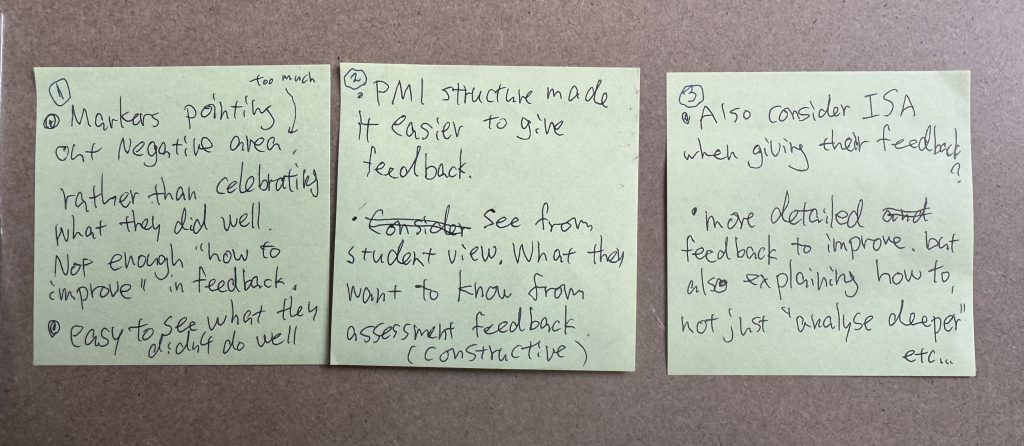
In response, I increased the number of group feedback sessions where tutors speak to each group and student to create more consistent communication points in 25/26. However, engagement was not as active as I had hoped. This varied by cohort—groups who felt relaxed and knew each other well were more willing to give and receive feedback. Cultural background also played a role: some students had never been encouraged to question tutors, while others felt shy or anxious about giving and receiving negative comments, which sometimes resulted in polite “lip service” rather than meaningful critique.
O’Donovan, Price and Rust (2004) argue that carefully worded feedback can still hold little meaning if students do not understand how to use it. They cite Maclellan’s finding that “most students do not view feedback on their learning as either routinely helpful in itself or as a catalyst for discussion” (Maclellan, 2001, cited in O’Donovan, Price & Rust, 2004). This suggests that simply increasing feedback opportunities is insufficient; students need clearer guidance on how to interpret feedback, act on it and use discussion to clarify expectations. It is therefore important that we explain why feedback, presentation and communication skills matter, and how developing these abilities strengthens reflective practice and supports students beyond university, and contributes to their future employability.
Developing teacher–student relationships
Learning students’ names has been an important step in strengthening relationships. I now make a conscious effort to talk with students before class, which has reduced the formality and distance I previously maintained—partly because I was unconsciously modelling the traditional teaching style I experienced in Japan. These informal conversations have encouraged greater openness and helped me notice concerns earlier. Through this process, I realised that the teacher–student relationship in the UK differs from what I grew up with, and adapting to these cultural and generational expectations has been necessary. Observing colleagues has also helped me understand how they communicate, structure sessions and build trust. By being more approachable and attentive, I have become more aware that many students experience significant stress during the second unit, and attendance drops noticeably after December. This highlights the need to continue improving communication, consistency and pastoral support across the course.
International students and inclusive learning
I have also noticed disengagement among some international students. Bamber and Jones (2015) emphasise the importance of clear explanations for supporting international learners. Teachers need to be explicit about aims, objectives and expectations, and communicate these in ways students genuinely understand—for example, by explaining instructions directly rather than relying on brief handbook statements. This reflects my experience that these students are not disengaged due to a lack of ability, but because expectations are not always made transparent.
Moving forwards
Although we cannot introduce an additional pastoral tutorial within the current scheme of learning, the students who most need help are often those who do not attend. Working closely with the disability officer and mental health adviser has been valuable in helping me recognise signs of struggle and understand how to support students appropriately. Regularly checking attendance and engagement data also assists with early identification.
I have been in touch with the Language Development Officer about the academic support available. Being a student again on the PG Cert has reminded me what it feels like to seek help, strengthening my empathy for students navigating similar challenges. Moving forward, I will make lectures and seminar activities clearer by outlining aims and linking learning outcomes to the theme. Explaining how each session connects to practice should reduce confusion and strengthen engagement. I will continue observing colleagues and developing my practice.
References
O’Donovan, B, Price, M and Rust, C. (2004) ‘Know what I mean? Enhancing student understanding of assessment standards and criteria’, Teaching in Higher Education, 9: 3, pp. 325-335
Bamber, V. and Jones, A. (2015) Enabling Inclusive Learning, pp. 152-168
Leave a Reply