Blog

  • IP Reflective Report

    Introduction

    In response to unconscious bias and the persistence of degree awarding gaps, I am developing a range of inclusive strategies to implement in my teaching practice. These strategies aim to better support Year 1 students, particularly in fostering confidence, academic skills, and a sense of belonging. Particular attention will be given to first-generation university students, those with identified learning needs, students for whom English is a second language, and students from Black, Asian, and Minority Ethnic backgrounds.

    At the same time, I recognise that my own positionality influences classroom dynamics. As a lecturer who does not identify as White, I am aware that this does not eliminate unconscious bias. It requires ongoing reflection to ensure that support is distributed equitably and not shaped by assumptions, which I now recognise as a form of bias that risks overlooking individual needs and reinforcing inequalities in student support.

    Context

    Pallavi (2024) explores the relationship between academic staff and students, highlighting how limited opportunities for engagement can contribute to lower academic achievement and wider degree awarding gaps. At London College of Fashion (LCF), students are typically on campus only two days per week due to the increasing cost of living in London. Many students also undertake part-time work, which reduces the time available for independent study. As a result, there is less opportunity for sustained interaction between students and academic staff.

    Increased engagement between staff and students can help reduce awarding gaps by providing students with the support and resources they need to succeed (Pallavi, 2024, p. 43). In response, a key focus of my practice is supporting Year 1 students’ transition into academic learning. I plan to work closely with the Academic Support team to help students develop reading, writing, and critical thinking skills. Providing examples of previous research journals early in Unit 1 will clarify expectations and reduce uncertainty. In seminars, I will introduce structured reading materials alongside clearer guidance on visual analysis, enabling students to articulate their ideas more confidently.

    Pallavi (2024), drawing on DiMaggio (1982), highlights the importance of cultural capital:

    “Cultural capital, as measured by participation in activities such as reading literature and attending museums, has a significant positive effect on students’ grades.”

    Studying in London, and particularly at UAL, offers significant access to collections, museums, galleries, and cultural resources. To address disparities in cultural exposure, I will incorporate visits to institutions such as the V&A East, V&A Storehouse, the Photographers’ Gallery, and the National Portrait Gallery within Unit 1. These activities aim to enhance both technical learning and critical engagement with visual culture, while supporting students who may not otherwise have access to these resources.

    Inclusive Learning

    As a disabled student undertaking the PGCert, I have developed a clearer understanding of institutional support processes through working with Disability Officers. This experience informs my teaching practice by enabling me to interpret Individual Support Agreements (ISAs) more confidently and implement appropriate adjustments.

    From personal experience, I recognise that students are often unaware of the support available and may find it difficult to ask for help, particularly when specialist resources or expensive equipment are involved.

    This is reflected in wider research. Evans (2022) notes that disabled individuals experience structural inequalities, including lower levels of education and well-being (Office for National Statistics, 2020). Students with disabilities are also more likely to experience degree awarding gaps due to a lack of accessibility and support in higher education (Pallavi, 2024, p. 33).

    In addition, Evans (2022) highlights that negative portrayals in the UK media—for example, framing disabled people as “scroungers” (Ryan, 2019, cited in Evans, 2022, p. 990)—may further discourage individuals from seeking support.

    Supporting disabled students is therefore essential for improving both learning experiences and long-term outcomes. Disability is also highly intersectional. Evans (2022) emphasises that disabled individuals should not be treated as a homogeneous group, as needs and experiences vary significantly. This reinforces the importance of adopting flexible and responsive teaching approaches.

    In my own experience, disability has provided an alternative perspective on the world, allowing me to recognise issues I had not previously considered. Being inclusive requires actively attempting to see from different viewpoints, particularly in understanding how students experience learning in the classroom.

    To address these challenges, I plan to:

    • Provide a recorded introduction from a Disability Officer, shared both in class and on Moodle
    • Offer a weekly 30-minute drop-in tutorial session before lectures for troubleshooting and support, which may also contribute to improved attendance

    Confidence-building is another key priority. Many Year 1 students experience anxiety when presenting ideas, so I will introduce low-stakes group activities to gradually build confidence. For example, students will collaborate on short pitches before presenting to larger groups. I will also signpost support from Language Development Officers, who can help students develop their academic and presentation skills through bookable tutorials, as these resources are often underused.

    Collaboration presents further challenges, particularly where students may self-segregate along cultural or social lines. I will design structured group activities that encourage interaction across diverse perspectives, with an emphasis on inclusion and active listening.

    At a broader level, I also recognise the importance of representation. Limited diversity within teaching teams may influence students’ sense of belonging. In response, I will diversify references, case studies, and visual materials to reflect a wider range of perspectives.

    Evaluation

    Reflecting on this year’s teaching, I have identified areas for improvement in communication and student engagement. One key challenge is maintaining student’s attention in an environment shaped by digital distraction and reduced concentration.

    Student feedback (CSS data) indicated that:

    • “How often do teaching staff make the subject engaging?” scored 73%
    • “How often is the course intellectually stimulating?” scored 73%
    • “To what extent have you had the chance to bring together information and ideas from different topics?” scored 77%
    • “How often does your course challenge you to achieve your best work?” scored 79%

    These results suggest that while students are engaged, deeper critical thinking remains an area for development. This is reflected in students’ work, particularly in the third unit “Fashion Moving Image Production”, where research often remains at a surface level.

    To address this, I will:

    • Introduce structured reading tasks and guided discussions
    • Encourage deeper critical engagement in seminars
    • Provide additional academic resources and scaffolding

    Within the first unit “Introduction to Fashion Media”, I will:

    • Introduce visual methodologies for analysing fashion images
    • Support research development using tools such as a customised Copilot agent to locate both supporting and critical reading materials alongside library resources.
    • Organise regular gallery and museum visits to build cultural capital
    • Provide weekly reading materials to support independent learning

    These strategies aim to strengthen critical thinking, research depth, and student confidence. Through cross-course discussions, I learned that other lecturers have used animated GIFs and interactive tools effectively. I experimented with incorporating GIFs and Mentimeter into a lecture on a Japanese filmmaker. These tools encouraged students to actively participate through watching, voting, and commenting during the session. Mentimeter also helped me understand what individual students were thinking. This demonstrated that silence does not necessarily mean a lack of engagement. It helped students to get involved more actively during the lecture, and I could expand the discussion further as a result. I’d like to continue experimenting with various tools to explore how I can engage students.

    Negative comments from students:

    • More clearly outlined goals
    • I’d like more time in class to work on my project rather than listen to another lecture I can’t even do a page on because of the page count.
    • Lectures where they just read text from slides aren’t very interesting.
    • I’m tired of guest lectures and lectures in general, I don’t learn a thing. Please add more crit and assign more work to give crits on.
    • Lectures having a negative bias towards students who have to work.
    • Group projects.

    James and Brookfield (2014) explains how student learning “sticks” more when the same contents or skills are learned through multiple methods. I need to structure student learning experiences more effectively by working closely with workshop technicians to create a clearer connection between technical and theoretical teaching, and students’ own practice.

    To address this, I have started to support understanding by making clear connections between lectures and learning outcomes at the beginning of each session, breaking down academic language, translating key concepts, and guiding students through visual analysis since IP unit. Students were given time to reflect and engage critically with materials. I need to further develop engagement by incorporating more active learning approaches, providing more challenging tasks during sessions, and following these with short critique sessions in subsequent weeks.

    Conclusion

    Ultimately, addressing awarding gaps and unconscious bias requires both reflective teaching practice and broader institutional change. By focusing on belonging, accessibility, and representation, it is possible to create a learning environment in which all students feel supported and able to succeed.

    References

    Pallavi, B. (2024) Connecting the dots: A systematic review of explanatory factors linking contextual indicators, institutional culture and degree awarding gaps. Higher Education Evaluation and Development, pp. 31–52.

    Evans, E. (2022) Political intersectionality and disability activism: Approaching and understanding difference and unity. The Sociological Review, 70(5), pp. 986–1004.

    James, A. and Brookfield, S.D. (2014) Engaging imagination: helping students become creative and reflective learners, pp. 3-66
  • IP Blog3 Race – Understanding Belonging, Bias and Awarding Gaps

    Degree awarding gaps remain a significant issue in higher education, particularly affecting students from underrepresented backgrounds. Research highlights that a sense of belonging plays a crucial role in student success and progression. As Banerjee (2024, p. 43) argues, universities must actively create inclusive and supportive environments, particularly for students from marginalised groups. This suggests that issues of attainment cannot be separated from wider questions of inclusion, identity, and institutional culture.

    Belonging, however, is not experienced equally. It is often shaped by invisible structures of privilege and familiarity. DiAngelo (2011, p. 62) highlights that “it is rare for most whites to experience a sense of not belonging… racial belonging becomes deeply internalized and taken for granted.” This insight is particularly useful in understanding how unconscious bias operates within education. Belonging is therefore not simply a personal feeling, but a socially structured condition that influences how students are perceived, supported, and assessed.

    Unconscious bias can take multiple forms, including stereotyping, affinity bias, and the halo effect. These biases shape how educators interpret student behaviour, engagement, and ability. For example, students who appear confident or familiar may be more easily recognised as capable, while others—particularly those from different cultural, linguistic, or educational backgrounds—may be overlooked. These dynamics contribute to disparities in student experience and can reinforce awarding gaps.

    These inequalities are not only individual but also institutional. Concerns around curriculum bias have been increasingly raised, with initiatives such as the “Why is my Curriculum White?” movement highlighting the dominance of Eurocentric perspectives within higher education curricula (Wong et al., 2021). This reflects wider concerns that higher education structures may privilege certain cultural perspectives while marginalising others.

    Issues of belonging are also closely linked to cultural capital. Students from lower socioeconomic backgrounds may have had less exposure to cultural institutions, which can affect confidence and familiarity with artistic references. As Escobar (2018, p. 6) argues, diverse cultural traditions have historically been devalued, often reduced to “being worth nothing” under dominant narratives.

    Together, these perspectives highlight that belonging is not neutral. It is shaped by structural inequalities that influence how students engage with education. Addressing awarding gaps therefore requires more than awareness; it requires active changes in teaching practice and institutional culture.

    Reference

    Banerjee, P. (2024) ‘Connecting the dots: a systematic review of explanatory factors linking contextual indicators, institutional culture and degree awarding gaps’, Higher Education Evaluation and Development, 18(1), pp. 31–52

    Escobar, A. (2018) Designs for the pluriverse: Radical interdependence, autonomy, and the making of worlds. Durham: Duke University Press. pp. 1–21

    DiAngelo, R. (2011) ‘White fragility’, International Journal of Critical Pedagogy, 3(3), pp. 54–70

    Wong, B., Elmorally, R., Copsey-Blake, M., Highwood, E. and Singarayer, J. (2021) ‘Is race still relevant? Student perceptions and experiences of racism in higher education’, Cambridge Journal of Education, 51(3), pp. 359–375

  • IP Blog2 – Intervention

    Riedel and Rau point out that “in a Western context where Christianity remains the cultural norm, different religions are positioned differently vis-à-vis each other, which raises questions of power.” (2025, p 2)  As an Asian lecturer from a non-Christian background, I am also conscious of my role in shaping an inclusive learning environment. Rather than assuming neutrality, I recognise the importance of creating a classroom that is not centred around any single cultural or religious perspective.

    Fashion photography is traditionally a white, male‑dominated industry. As a result, many references continue to come from Western contexts, with fewer examples from non‑Western perspectives. To address this, I actively seek out contemporary fashion photographers from around the world through events such as Photo London, the UK’s leading international fair for photography and image‑based art. Each year, it brings together well‑established photographers, galleries, and curators alongside emerging talent, offering a wider range of perspectives.

    This raises critical questions about inclusivity and belonging in practice. Do all students feel invited to participate? Are students able to discuss their beliefs openly, or do they feel the need to conceal aspects of their identity? For example, it is important to consider whether students from Muslim, Jewish, or other religious backgrounds feel equally welcomed and represented within the classroom.

    These reflections suggest that inclusivity is not only about introducing diverse content, but also about ensuring that different forms of identity, including faith, can be expressed safely. As an educator, my role is to create a space where students feel respected and able to engage in dialogue, while maintaining a sensitive and supportive learning environment.

    Riedel and Rau further argue that “treating religion and race separately risks missing the specificities of how people experience discrimination and marginalisation as well as dominance and privilege within intersecting power structures based on religion and race. Moreover, an intersectional approach also invites us to consider how our categories of analysis have been shaped by focusing on the experiences of certain groups over others.” (2025, p 4). This highlights the importance of an intersectional approach in teaching.

    In responding to this, it is important to maintain an analytical rather than a confrontational approach. Instead of comparing different religions or beliefs, teaching can be structured around critical observation and reflection. For example, asking “In many societies, certain groups have more visibility or power. How is this reflected in fashion imagery today in the UK or in your home country?” allows students to engage through visual analysis rather than focusing on their own faith or beliefs. Further questions such as “Who is usually represented in fashion images? Who is missing? How are people styled or positioned? Who controls the image?” could encourage discussion without causing discomfort. Students can then analyse a fashion image and identify who has power in the image and who does not. This approach allows them to explore sensitive issues indirectly, reducing the risk of discomfort while still developing critical awareness.

    Reference

    Riedel, M. and Rau, V. (2025) ‘Religion and race: the need for an intersectional approach’, Identities.

  • IP Blog2 – Faith Belief and Religion

    I am a straight Japanese male from a Buddhist family with a Shinto background. But since becoming a disabled person, I have developed a stronger belief in science and evidence-based understanding. This shift in perspective has made me more aware of how different belief systems influence the ways in which we understand knowledge and reality.

    LCF is part of the University of the Arts London (UAL), which is committed to creating a fairer and more inclusive environment for all staff, students, and the wider university community. However, as discussed in debates around secularism in higher education, “secularism does bring its own metaphysical commitments to reality and hence the place is not neutral” (Qureshi, in Heterodox Academy, n.d., 26:55).

    This perspective has encouraged me to critically reflect on both the institution and my own teaching practice. It suggests that what may appear to be neutral or objective within higher education can still be shaped by underlying assumptions about knowledge, which may unintentionally privilege certain perspectives while marginalising others.

    This also raises important questions around freedom of expression within the classroom. Within my teaching context, Year 1 students engage with themes such as intersectionality, identity, and pluriversal perspectives in Fashion Image making. While these approaches aim to promote inclusivity, they can also create challenges for some students when navigating unfamiliar or sensitive topics.

    For example, students who have had limited exposure to diverse perspectives—whether due to geographical, cultural, or social background—may lack confidence in contributing to discussions or producing work in these areas. Some may feel that their own experiences are not sufficiently recognised within these frameworks.

    At the same time, there may be students who hold different cultural, ideological, or religious beliefs and feel uncertain about expressing their views within a diverse and inclusive learning environment. Concerns about being misunderstood or causing offence can lead to self-censorship, limiting open dialogue and critical engagement. As Harne suggests, while diversity is widely valued, “we’re always in the process of making judgments about which viewpoints are worthy of bringing into an undergraduate course and which ones aren’t” (Harne, in Heterodox Academy, n.d., 30:36).

    For example, discussions around gender and sexuality—such as same-sex marriage—are often framed within contemporary progressive perspectives. While this is important for promoting inclusivity, it may unintentionally exclude or silence students whose beliefs are shaped by different cultural, religious, or traditional values. For example, against same sex marriage might be seen as outdated, narrow minded.

    These tensions highlight the importance of creating a classroom culture that supports both inclusivity and respectful dialogue. As an educator, this requires careful facilitation to ensure that students feel safe to express differing perspectives, while also engaging critically and respectfully with others.

    Reference

    Heterodox Academy (n.d.) Faith and truth-seeking: What is the role of religion in higher ed? Available at: https://www.youtube.com/watch?v=u4uZjlwLFUk (Accessed: 9 May 2026).

  • IP Blog 1 Disability

    I am a disable, middle age, Japanese, married man who studied Fine Art in both Japan and UK, and these aspects of my positionality intersect and shape how experience teaching and learning environment.

    From reviewing interviews and short films by disabled individuals, as well as reflecting on my own experience, I strongly agree that environments can disable people. Many individuals are not inherently “disabled” in all contexts; rather, they become disabled when environments are not designed to support their needs

    This idea is reflected in several of the interviews, where participants describe how barriers in public or institutional spaces—such as inaccessible buildings or inflexible schedules—limit their participation. These barriers often intersect with other aspects of identity. For instance, individuals from lower socioeconomic backgrounds may have limit financial support to come to a campus more than 2 days per week, and access to supportive resources, while those who are non-native speakers may face additional communication challenges.

    From a teaching perspective, this highlights the importance of removing barriers to learning. For example I have a mic and speaker in my classroom after students pointed out that sometimes my voice was too quiet (I have a half deaf and sometimes I don’t know how loud I’m speaking). It is also important to face students while I deliver because, I also rely on lip reading. Same goes to keeping the classroom quiet. Not everyone like to speak up in a classroom. Some students struggle having a group discussion in loud environment too. Providing clear instruction is important for not only international students but also for dyslexic students. Offering materials in multiple formats, allowing extra processing time, and ensuring physical accessibility—can significantly improve students’ experiences. These changes do not lower academic standards; rather, they create a more inclusive environment where all students have the opportunity to succeed.

    However, parity and equality often come to my mind. I must offer same amount of hours for tutorial if I wanted to support a student who having problems learning.

    Overall, both the interviews and my own experience reinforce the idea that disability is not only a personal condition but also a result of environmental design. By recognising this, educators can take practical steps to reduce barriers and support diverse learners more effectively.

  • Case Study 3: Assessing learning and exchanging feedback

    Background

    One early Year 1 activity asks students to share their fashion photography practice. However, some students experience heightened anxiety when viewing strong peer portfolios and can interpret critique negatively rather than as inspiration. This can also lead to a fear of presenting their work‑in‑progress in front of the cohort. These reactions indicate a need to help students reframe feedback as constructive rather than threatening. Jain (2022) argues that critical disability theory is an essential lens for developing more inclusive approaches to assessment. In response, we have discussed practical adaptations such as introducing a “buddy system” and allowing students to submit pre‑recorded video presentations. These options can help reduce anxiety, especially for students with limited English or limited confidence.

    Evidence

    Students face multiple hurdles in Year 1: moving to London, adjusting to unfamiliar studio environments, working with limited English, and coping with last‑minute issues such as model or stylist cancellations. Many enter the course with high expectations, so when grades do not match these expectations, disappointment can make feedback feel personal. Yet genuine learning often emerges through mistakes—a message that some students have not yet fully internalised.

    (James and Brookfield, 2014, p. 12)

    A recent microteaching activity focused on OBL reinforced these insights. During a short ten‑minute iterative design task, we were asked to improve our paper‑aeroplane designs. Some of my peers managed to improve their planes, while mine actually performed worse. However, this did not mean I learned nothing. In fact, I learned more from analysing my mistakes than from any successful attempt. James and Brookfield (2014) describe reflection as a blend of thinking, questioning and examining over time, and this exercise demonstrated that encountering a challenge or failure is central to learning. Among various reflection models, I believe that Rolfe’s “What? So what? Now what?” framework offers a simple and accessible approach for Year 1 students to begin reflective practice.

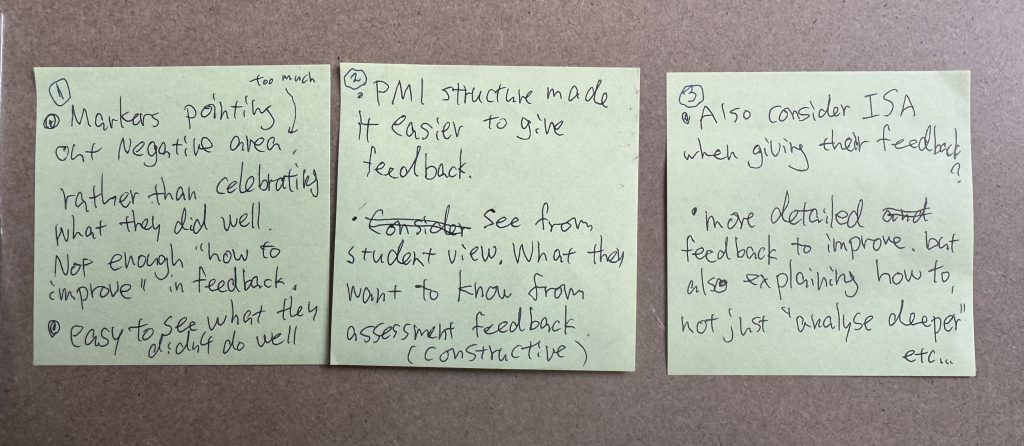
    Feedback practice among markers also requires attention. Through double marking, I have observed inconsistencies in feedback language among HPL colleagues. Some comments focus on what students “did badly,” while others rely on vague directions such as “needs more critical analysis” without explaining how to do this. We are limited to 250 words of written feedback, so it is sometimes difficult to be fully descriptive. However, we must remember that our students are at the very start of their academic journey and often need clearer instruction. We must also recognise learner sensitivity and nurture a culture of caring, specific and actionable feedback—especially for students with ISA agreements. In addition, many of today’s students have been shaped by smartphones, AI, and post‑COVID study habits, all of which influence how they process information and manage pressure. This makes clear guidance and supportive structures even more essential.

    Moving forward

    To build confidence, the first unit should begin with short, low‑pressure pair‑feedback tasks. As students become more comfortable, we can introduce anonymous activities using tools such as Padlet or Mentimeter. These allow students to share responses without fear of judgement, helping them focus on analysing the work rather than managing stress. Giving feedback to peers is also a valuable way to develop critical thinking and communication skills. Over time, these activities support students in becoming more self‑regulated learners.

    As confidence grows, WIP crits can become more meaningful and reflective. Students can be guided to offer concrete and specific comments, consider multiple perspectives from their diverse peers and tutors, and make explicit links between feedback and the learning outcomes. They can also learn to identify one or two actionable next steps and explain how they plan to apply these to their work. The aim is to shift feedback from something that feels emotional or discouraging into a regular and constructive part of their creative development, supporting ongoing reflection and improvement in a more confident and sustainable way.

    References

    Jain, N. (2022) ‘Why crip assessment? Critical Disability Studies theories to advance assessment for inclusion’, in R. Ajjawi, J. Tai, D. Boud, J. Jorre de St Jorre (eds.) Assessment for Inclusion in Higher Education: Promoting Equity and Social Justice in Assessment. Routledge: Oxon, pp. 30-40.
    James, A., & Brookfield, S. (2014). Engaging Imagination: Helping students become creative and reflective thinkers. pp. 3-23

  • Case study 2: Plan for and support student learning through appropriate approaches and environments

    Contextual background

    In the most recent student survey, the word communication appeared repeatedly across Years 1, 2 and 3. Students reported that HPLs were often unaware of what colleagues were teaching and that communication between HPLs and technicians was also inconsistent. Some tutors also gave different answers to the same question, creating unnecessary confusion. As a result, students felt their voices were not being heard and that there was a lack of coherence across the teaching team.

    Evaluation

    In response, I increased the number of group feedback sessions where tutors speak to each group and student to create more consistent communication points in 25/26. However, engagement was not as active as I had hoped. This varied by cohort—groups who felt relaxed and knew each other well were more willing to give and receive feedback. Cultural background also played a role: some students had never been encouraged to question tutors, while others felt shy or anxious about giving and receiving negative comments, which sometimes resulted in polite “lip service” rather than meaningful critique.

    O’Donovan, Price and Rust (2004) argue that carefully worded feedback can still hold little meaning if students do not understand how to use it. They cite Maclellan’s finding that “most students do not view feedback on their learning as either routinely helpful in itself or as a catalyst for discussion” (Maclellan, 2001, cited in O’Donovan, Price & Rust, 2004). This suggests that simply increasing feedback opportunities is insufficient; students need clearer guidance on how to interpret feedback, act on it and use discussion to clarify expectations. It is therefore important that we explain why feedback, presentation and communication skills matter, and how developing these abilities strengthens reflective practice and supports students beyond university, and contributes to their future employability.

    Developing teacher–student relationships

    Learning students’ names has been an important step in strengthening relationships. I now make a conscious effort to talk with students before class, which has reduced the formality and distance I previously maintained—partly because I was unconsciously modelling the traditional teaching style I experienced in Japan. These informal conversations have encouraged greater openness and helped me notice concerns earlier. Through this process, I realised that the teacher–student relationship in the UK differs from what I grew up with, and adapting to these cultural and generational expectations has been necessary. Observing colleagues has also helped me understand how they communicate, structure sessions and build trust. By being more approachable and attentive, I have become more aware that many students experience significant stress during the second unit, and attendance drops noticeably after December. This highlights the need to continue improving communication, consistency and pastoral support across the course.

    International students and inclusive learning

    I have also noticed disengagement among some international students. Bamber and Jones (2015) emphasise the importance of clear explanations for supporting international learners. Teachers need to be explicit about aims, objectives and expectations, and communicate these in ways students genuinely understand—for example, by explaining instructions directly rather than relying on brief handbook statements. This reflects my experience that these students are not disengaged due to a lack of ability, but because expectations are not always made transparent.

    Moving forwards

    Although we cannot introduce an additional pastoral tutorial within the current scheme of learning, the students who most need help are often those who do not attend. Working closely with the disability officer and mental health adviser has been valuable in helping me recognise signs of struggle and understand how to support students appropriately. Regularly checking attendance and engagement data also assists with early identification.

    I have been in touch with the Language Development Officer about the academic support available. Being a student again on the PG Cert has reminded me what it feels like to seek help, strengthening my empathy for students navigating similar challenges. Moving forward, I will make lectures and seminar activities clearer by outlining aims and linking learning outcomes to the theme. Explaining how each session connects to practice should reduce confusion and strengthen engagement. I will continue observing colleagues and developing my practice.

    Experiences, Insights & Expectations

    References

    O’Donovan, B, Price, M and Rust, C. (2004) ‘Know what I mean? Enhancing student understanding of assessment standards and criteria’, Teaching in Higher Education, 9: 3, pp. 325-335
    Bamber, V. and Jones, A. (2015) Enabling Inclusive Learning, pp. 152-168

  • Revised Reflection 4: Theories, Policies and Practices

    During the session, we discussed the shift in higher education from training people for fixed professions to producing new knowledge and fostering critical thinking and inclusivity. As a Japanese person with a disability living in the UK, inclusivity and equality are the areas I feel most connected to.

    Coming from Japan, I sometimes feel less confident discussing decolonisation, which often centres on conversations between Black and White communities, compared with discussions around racism, which I have personally experienced. However, I have noticed major changes in both higher education and the art world. When I was a university student over 25 years ago, I do not remember learning about many artists from B.M.A.E. background. Later, when working closely with artists and galleries, I witnessed the industry slowly beginning to represent more Black, Asian and female artists, gradually giving them deserved recognition. Working with The Gallery of Everything, which represents outsider artists, also widened my understanding of the question: What is art? Who decides? Do large established galleries define it, or can it come from outside traditional systems?

    Hooks (1995) quotes Lucie‑Smith, noting that “the work of art is no longer seen as something which truly represents its time and is important to it unless it challenges the norms of that time.” I strongly agree. Sometimes it feels as though, unless you “bite back” at society, the work is ignored. Everyone has a voice, but the challenge is helping students recognise what their voice is. Does meaningful work always need to challenge society? If not, is it still valuable?

    This also reminded me of a student who described herself as “boring” because she is a white, straight woman who does not have a disability or close friends from minority background. Her positionality make her feel her work is worthless. Some home students struggle with the theme of inclusivity; even mixing with peers from diverse backgrounds in a university environment can still feel unfamiliar to them. They often feel their everyday experiences are not as “strong” as more personal themes such as B.A.M.E. and LGBTQ+ identity, which can feel more immediate or visible and they feel disadvantaged. DiAngelo (2011) explains that racial segregation can feel invisible to those who benefit from it, which makes conversations about racism difficult. This may also explain why some home students who come from outside London struggle with this unit.

    To address this, we need to create more safe space in our teaching to discuss white privilege and how racism elevates white people within social structures. However, Wilson (2021) notes that many students leave these conversations feeling hopeless or helpless. She also cites Diane Goodman’s observation that:

    Wilson emphasises the importance of contemplative practices, such as meditation, mindfulness, compassionate listening and journaling to support students who struggle with these discussions and to help them engage more openly. My role is to guide and support all students in understanding that every perspective is valid and meaningful within a broader social and cultural context. Providing clear starting points—such as discussing whiteness and its influence on lived experience—can help students enter these conversations with greater confidence.

    Reference

    Hooks, B (1995) Art on my mind, Talking Art as the Spirit Moves Us, pp 101-107
    Diangelo, R (2011) International Journal of Critical Pedagogy, Vol 3 (3) White Fragility, pp 55-70
    Wilson, C (2021) A Contemplative Pedagogy: The Practice of Presence When the Present is Overwhelming pp 52-62

  • Case Study 1: Knowing and responding to your students’ diverse needs

    Background

    I am the Year 1 leader for the BA Fashion Photography course. At the moment, there are 59 students in the 2026 cohort, with a wide range of skill levels and learning needs. The aim of the first two units is to introduce the concepts of inclusivity, diversity and equality, and to run workshops that help bring everyone’s technical abilities to a similar level. These units also support students in learning how to study in an academic environment and how to begin working as professional fashion photographers. A key challenge is supporting students who experience anxiety, especially when this is linked to assessment pressure, confidence in their creative ability, or the fear of not producing “good enough” work.

    Evaluation

    When alumni visited during the second unit, they spoke honestly about how pressured they had felt in Year 1 when asked to collaborate and network. Many had never shot in a studio before university, and some had only collaborated with friends. Their comments helped me understand why several current Year 1 students looked overwhelmed after Christmas. Many appeared stressed, confused, and unsure of how to progress with their first assessed unit. To support them, I monitored attendance closely and reviewed the work of students who had lower attendance. This helped me identify concerns early and reduce pressure where possible.

    Building Confidence

    Collaboration is an essential part of Fashion Photography, but for many students it is unfamiliar and intimidating. Most of them have moved to London for the first time and hardly know anyone. To support this transition, I have reached out to the Fashion Styling and Production team to organise a Year 1 mixer during Unit 1, giving students a chance to meet, connect and build early working relationships. Although we encourage collaboration, I realised it is important to offer options so students can decide how much they want to take on.

    Finally, Arao and Clemens (2021) note that “interrupting someone who is speaking is a form of disrespect”, which I strongly relate to. However, they also explain that “in some cultural contexts interruption and talking over one another is welcome”. These cultural differences can make discussion overwhelming for some students. In a diverse classroom, communication styles will inevitably clash, so it is important to find ways to support everyone and create an environment where all voices can be heard. This could be solved by using written format or having a rule such as “one person speaks at a time”.

    Moving Forward

    Allowing thinking time before discussion will also support participation. Arao and Clemens (2021) note that “some might have been formulating a thought to share with the group. Some might have been very uncomfortable with the topic and decided they were unable to rise to the challenge of discussion.” International students and students with ISA particularly benefit from extra processing time. This has helped me understand the importance of knowing who has an ISA in the group so I can offer the right support when needed. 

    I am considering adding more detailed slides that demonstrate my thought process step by step. Some students freeze when questions are too open. Structured prompts—such as multiple-choice options or asking students to choose from three interpretations—can reduce anxiety and make analysis more accessible.

    Several students also struggle to understand how lectures relate to assessments. I can make this clearer in each session by explaining why the content matters and how to apply it to their practice. At the same time, I must avoid giving too many hints, as this can reduce independent learning. Finding the right balance between guidance and creative freedom will be an important part of my development moving forward.

    References
    Arao, B. and Clemens, K. (2021) From Safe Spaces to Brave Spaces, pp. 135–150.
    Bamber, V. and Jones, A. (2015) Enabling Inclusive Learning, pp. 152-168